Automated SERP Analyzer to dominate search results.Scrape competitor structures, extract real on-page data, and run deep Google analysis.
Everything you need to
outrank your competition.
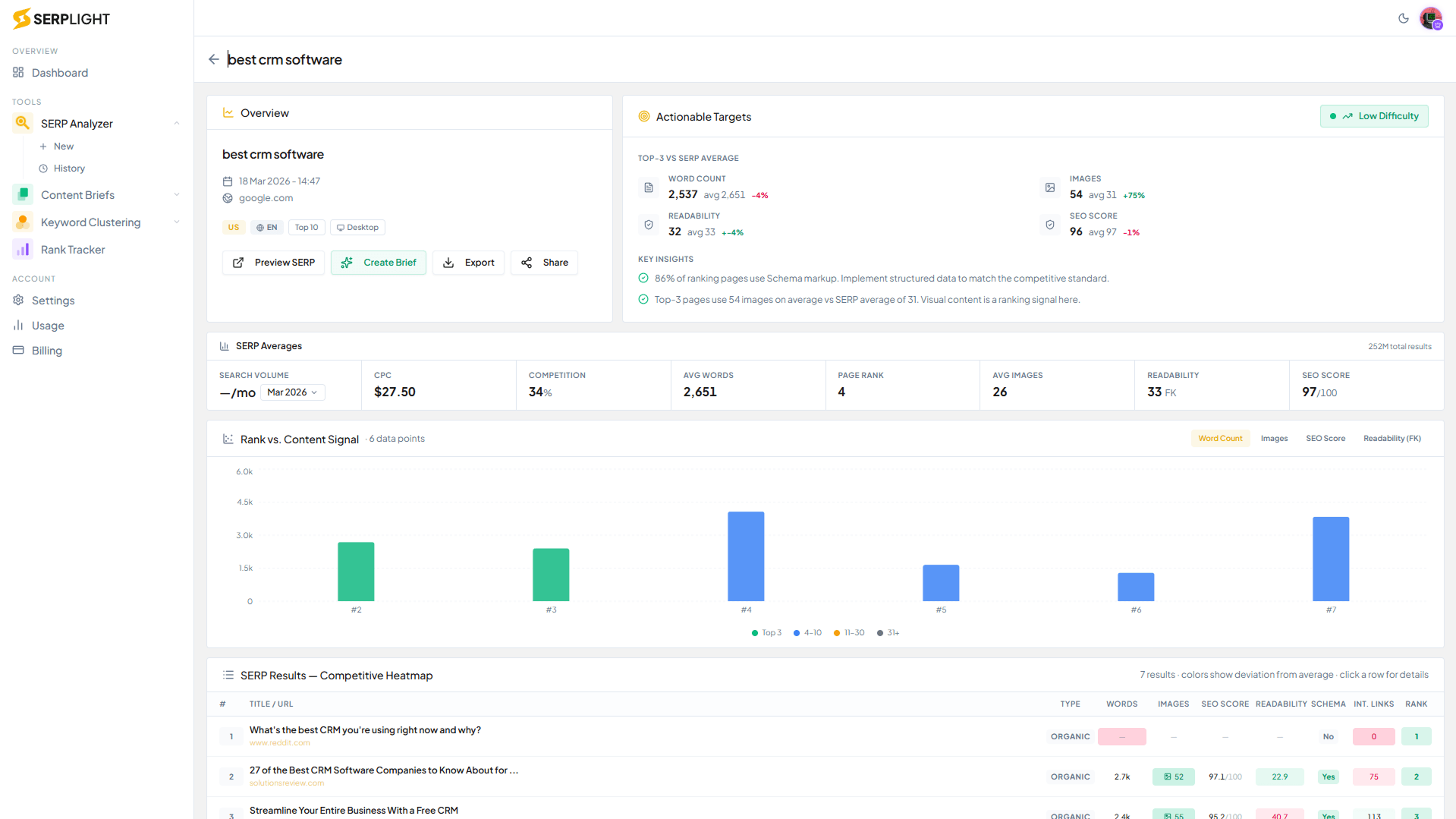
Automated SERP Analysis
Analyze the top 10–100 organic Google results instantly. Get a complete, automated SERP analysis without relying on outdated cached data.
SERP Competition Analyzer
Scrape your competitors directly. Extract real headings (H1–H3), exact word counts, and link profiles to outrank the current top 10.
Advanced SERP Analytics
Combine keyword-level data like search volume and CPC with deep SERP analytics to find the most profitable ranking opportunities.
SERP Feature Analysis
Detect Featured Snippets, local packs, and schema markup presence. Optimize your pages to capture highly visible SERP features.
All-in-One SERPs SEO Tool
Go from keyword to full competitive snapshot in seconds. Access readability scores, content gaps, and on-page data in one dashboard.
How the SERP Analyzer works.
A fast, data-driven way to reverse-engineer Google rankings with our automated SERP analysis engine.
Enter Keyword & Parameters
Input your target keyword, select the location, and let our online SERP analysis tool fetch the exact search results your audience sees.
Scrape Google SERPs
Our system performs an automated SERP analysis, scraping each ranking competitor for headings, word counts, links, and SERP features.
Review SERP Analytics
Use the extracted data to measure competition, spot content gaps, and build a reverse-engineered SEO strategy based on facts.
Deep SERP competition analyzer.
Scrape the actual top-ranking pages in Google and extract their headings, word counts, readability scores, and link profiles — all in a single, structured view.
Best Project Management Software 2024
techradar.com
12 Best PM Tools for Teams (Compared)
zapier.com
Project Management Software Reviews
g2.com
Top 10 Project Management Tools in 2024
forbes.com
Best Project Management Software Picks
pcmag.com
Comprehensive SERP analytics & metrics.
Combine keyword-level data like search volume, CPC, and difficulty with live SERP feature detection to find exactly where your ranking opportunities are.
Volume
12,100/mo
CPC
$4.50
Competition
87%
Difficulty
68/100
Avg Words
3,740
Avg Images
14
Readability
7.4 FK
Page Rank
6.2
SEO Score
74/100
Schema
80%
Frequently asked questions.
What is a SERP analysis tool?
A SERP analysis tool examines the top-ranking Google results for a specific keyword. Serplight acts as a deep SERP analyzer, scraping real on-page data like headings, word counts, readability, and SERP features to help you reverse-engineer the competition.
How does automated SERP analysis work?
When you enter a keyword, our system automatically fetches live Google results. It then visits each ranking URL, extracting critical SEO metrics and structural data in seconds, providing you with a complete SERP analytics dashboard.
Can I use this as a SERP competition analyzer?
Yes. Comparing your page against the top 10 results is the core function of our SERPs SEO tool. You can instantly spot content gaps, compare word counts, and see exactly what topics your competitors are covering.
Do you perform SERP feature analysis?
Absolutely. Our tool detects which SERP features (like People Also Ask, Featured Snippets, and Schema markup) are present for your query, helping you optimize your content to capture those specific real estate opportunities on Google.
Is the Google SERP analysis real-time?
Yes. We analyze live search results at the exact moment you run the query, ensuring your SERP analytics are completely up-to-date and not relying on stale databases.
Ready to get started?
See exactly what Google rewards - with real on-page data and SERP analytics.