Keyword Clustering Tool built on SERP intent.Automatically group hundreds of keywords into data-backed clusters, analyze live SERP overlap, and build flawless topical maps.
Everything you need to
outrank your competition.
SERP-Based Clustering
Group keywords by actual SERP overlap, not semantic guesses. When two keywords share ranking URLs, they belong in the same cluster.
AI Intent Detection
Automatically classify every cluster by search intent - informational, commercial, transactional, or navigational - so you know what type of content to create.
Bulk Keyword Processing
Upload or paste hundreds of keywords at once. Our engine clusters them in seconds, saving hours of manual spreadsheet work.
Volume & Difficulty Aggregation
See combined search volume and average difficulty for each cluster - instantly identify your highest-opportunity topic groups.
Content Strategy Mapping
Turn clusters into a content plan. Each cluster becomes a potential page with suggested content type, pillar/cluster hierarchy, and priority ranking.
How the Keyword Clustering works.
From a messy keyword list to a structured content strategy in three steps.
Import Your Keywords
Paste a list, upload a CSV, or pull keywords from your existing SERP analyses. Add up to 500 keywords per batch.
Analyze SERP Overlap
We fetch live Google results for each keyword and compare which URLs rank across multiple queries. Keywords sharing 3+ ranking URLs are grouped together.
Review & Refine Clusters
Explore your clusters with aggregated volume, intent labels, and content opportunity scores. Merge, split, or rename clusters to match your strategy.
Clusters built on real SERP data.
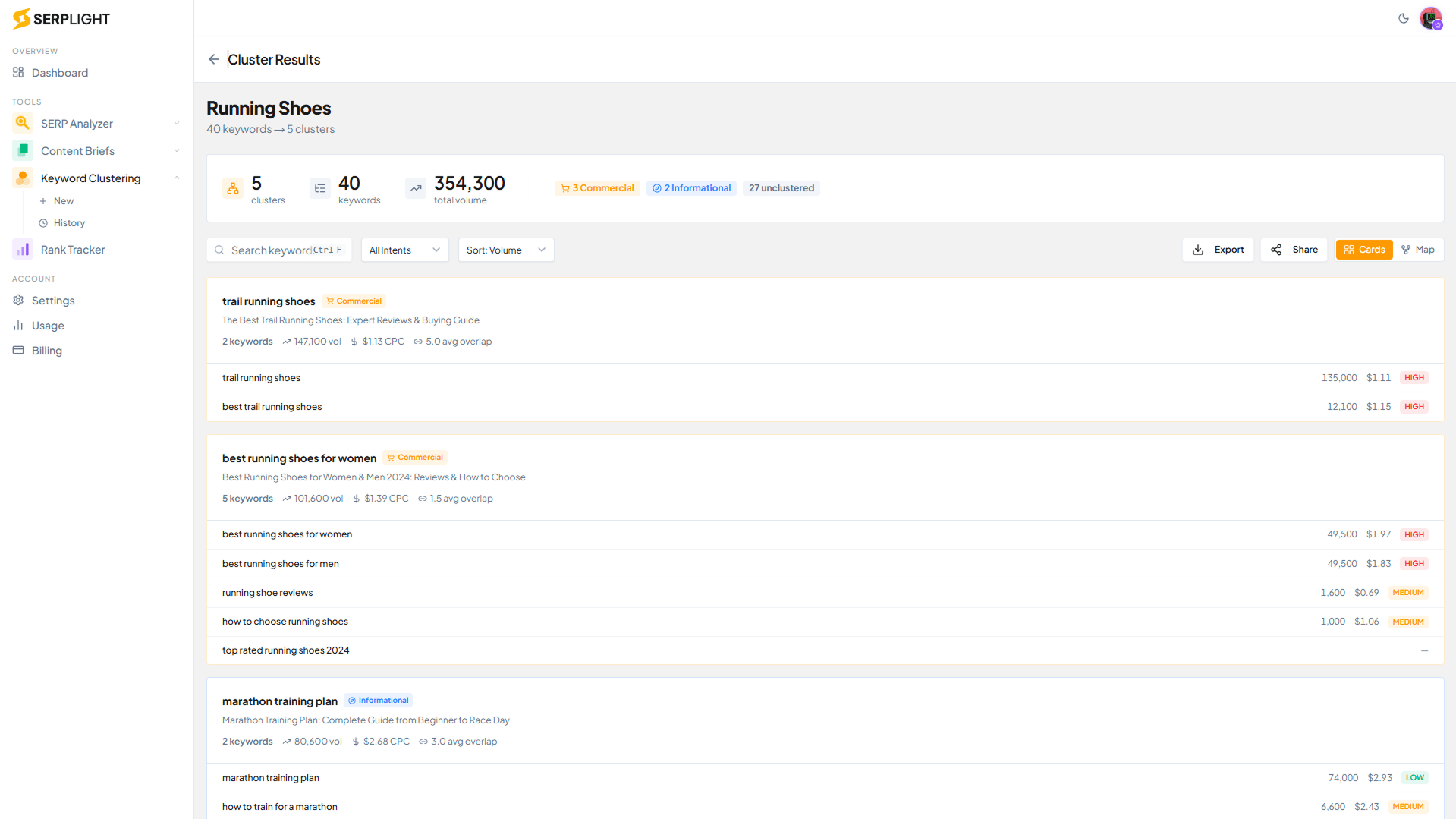
Group keywords by actual Google ranking overlap, not semantic guesses. If the same URLs rank for two keywords, they belong on the same page.
5
clusters
40
keywords
354,300
total volume
The Best Trail Running Shoes: Expert Reviews & Buying Guide
Best Running Shoes for Women & Men 2024: Reviews & How to Choose
From keywords to content strategy.
Each cluster surfaces aggregated volume, difficulty, intent, and content type — ranked by traffic potential so you know exactly what to write first.
Marathon Training Plan: Complete Guide from Beginner to Race Day
Best Running Watches with GPS: Top Picks & Comparison Guide
Frequently asked questions.
What is keyword clustering?
Keyword clustering is the process of grouping related keywords that can be targeted by a single page. Instead of creating separate pages for "best project management tools" and "top pm software," clustering reveals they belong together - because Google ranks the same URLs for both.
How does SERP-based clustering differ from semantic clustering?
Semantic clustering groups keywords by how similar they sound or look. SERP-based clustering groups them by real ranking overlap - checking whether Google actually serves the same results for two keywords. This is more accurate because it reflects Google's understanding of search intent, not just literal word similarity.
How many keywords can I cluster at once?
You can cluster up to 1,500 keywords per batch on the Pro plan, and up to 5,000 on the Agency plan. Each keyword triggers a real-time SERP lookup, so batch sizes are tiered to ensure data quality and speed.
What intent types are detected?
Serplight classifies every cluster into four intent categories: Informational (learning), Commercial (comparing), Transactional (buying), and Navigational (brand-seeking). Intent is determined by analyzing SERP features, result types, and page content across the cluster.
How is SERP overlap calculated?
For each pair of keywords, we compare the top 10 organic results. If 3 or more URLs appear in both result sets, the keywords are grouped into the same cluster. You can adjust the overlap threshold to make clusters tighter or broader.
Ready to get started?
Turn a messy keyword list into a data-driven content strategy.